Dedicated IPs

Both Amazon and DigitalOcean support allocating Static IPs.
Dedicated IPs are pre-allocated IP Addresses. Those IP addresses are automatically assigned to newly started cloud instances.
Dedicated IPs are a general name for:
- Elastic IPs on Amazon EC2,
- And Floating IPs on DigitalOcean.
It's highly useful when the tested application can only be accessed by whitelisted IPs. It allows you to use dynamically allocate cloud instances (billed per hourly rate) with always the same IP Addresses.
To hand the addresses to the team that maintains the allow-list, copy them from the table.
Configuration

From the providers list, expand the menu for an AWS or DO provider to see the Manage Dedicated IPs button.
Allocation
To allocate a new dedicated IP:
- Select the wanted region and availability zone,
- Click on
Allocatebutton.
Info
Contact us if you need to register existing dedicated IPs.
Copy the IPs
The Copy IPs button above the table copies every address of the provider, one per line. The list pastes as it is into a firewall allow-list or a spreadsheet column.
To copy only some of them, select their rows: the button becomes Copy N IPs and copies the selected addresses only.
Release
A dedicated IP stays allocated, and billed by the cloud provider, until you release it. To release one IP:
- Find it within the table,
- Hover its row, then click on its Release button,
- Confirm.
To release several IPs at once, select their rows, then click on Release N IPs and confirm once.
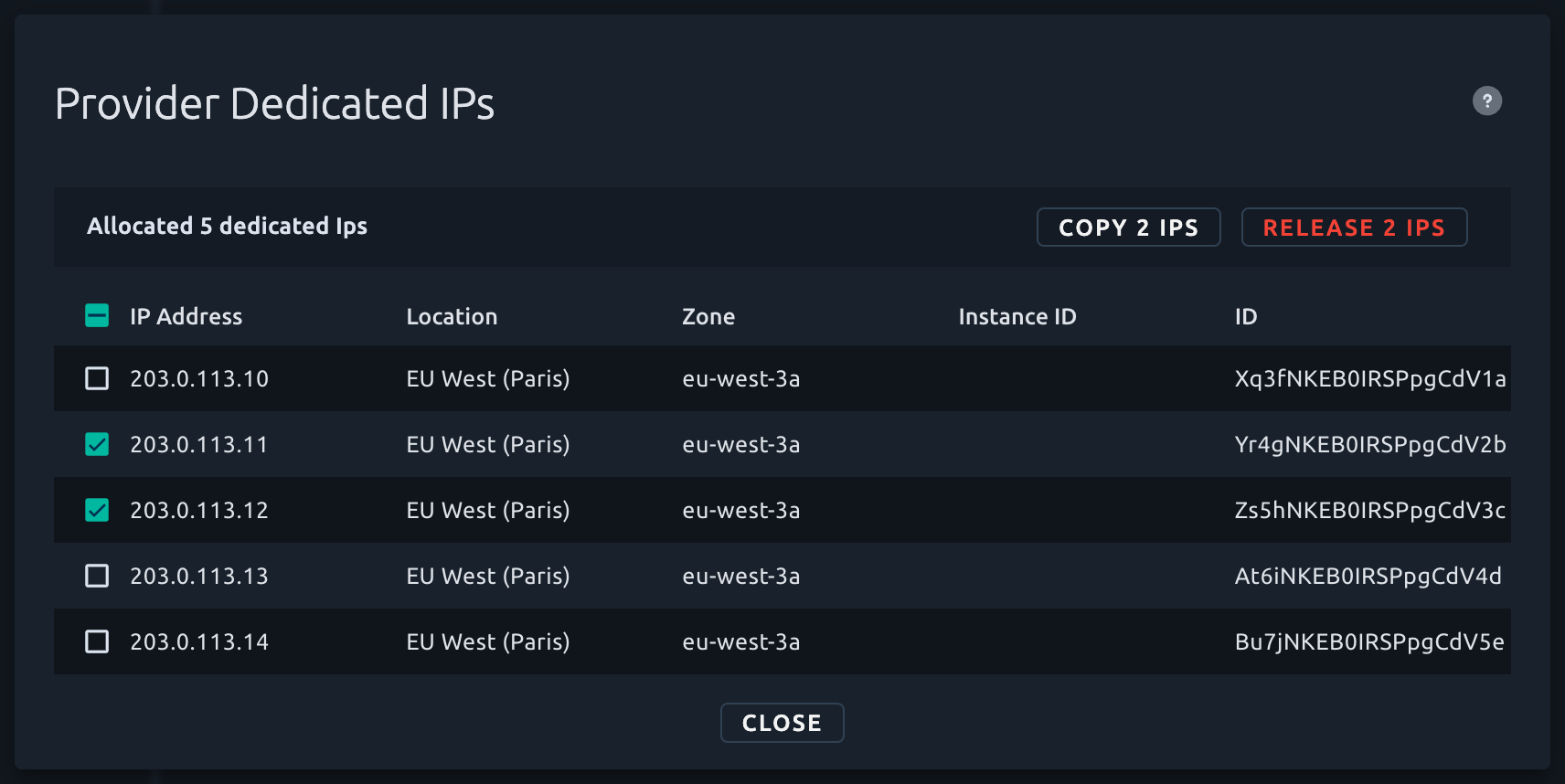
If the cloud provider refuses to release an IP (too many requests at once, a network error...), the IP stays in the table, and an error notification says how many IPs were not released: click on it to read the cause for each one. The IP is still allocated in your cloud account: release it again a few moments later.
An IP you already released from the console of your cloud provider is simply removed from the table.
Removing a provider releases all its dedicated IPs too, and the removal is refused while the cloud keeps one of them: see Remove an Existing Provider.
How it works
When a test is started:
- A new cloud instance is started,
- The system checks if any dedicated IP is available in the region where the instance is started,
- The static IP is associated to the new cloud instance.
When a cloud instance is terminated, any associated static IP is dissociated.
Warning
If your test requires more IPs than available you will be warned in the test log:
No static IP could be associated with instance leanora-padberg
In this case, new IPs will be assigned automatically by the clouder, potentially resulting in errors in your tests.