Simple Execution Scenario
A simple runtime scenario made of a single user profile (An advanced scenario has multiple user profiles). It allows you to easily compose a basic test with:
- a Virtual User,
- one test location (including cloud and on premise),
- a load policy,
- a behavior (like cache or cookies),
- etc...
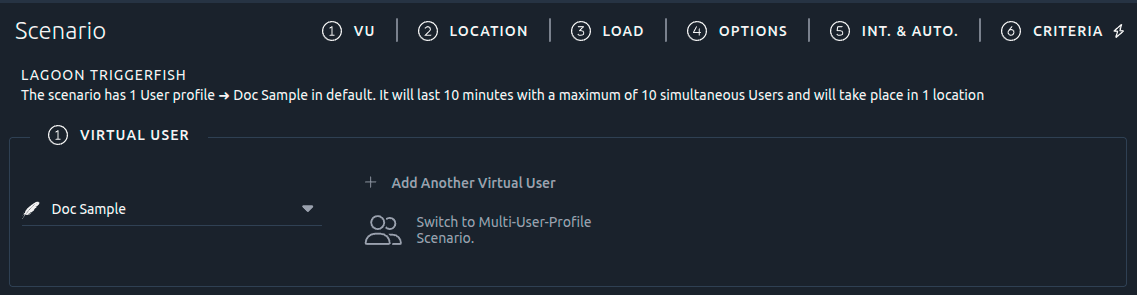
The edition page lets you configure each one of these parameters. You can click on the step headers in the upper right corner to quickly access:
Info
Several actions can be done by using the buttons in the upper right corner of the application header.

Please refer to the document at the end of this page for more information.
Virtual User

This step allows you to select the Virtual User that this Scenario will execute.
Info
It is only possible to select a single virtual user for a simple Scenario. Clicking on Add Another Virtual User converts the current scenario to a Multi-User-Profile scenario that allows you to have a scenario with several user profile, each-one configured with its own virtual user.
Location

This step allows you to select the location where the virtual user profile instances are being executed. You can select the Provider/Region using the select box. More information is available in the user profile location page.
Info
It is only possible to select a single location for a simple Scenario. Clicking on Add Another Location converts the current scenario to a Multi-User-Profile scenario that allows you to have a scenario with several user profile, each-one configured with its own location.
User Load Policy
This step lets you configure the user load policy for the current scenario.
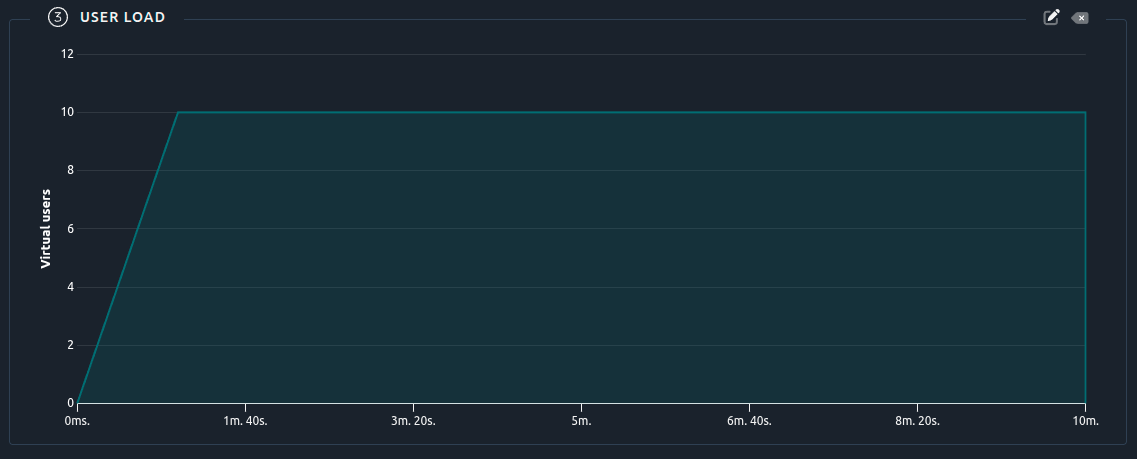
By default, it displays the current user load. Simply click on the chart or on the  icon to edit the curve.
The
icon to edit the curve.
The  icon resets the curve to its default value.
When editing the user load policy, the first step is to select the kind of policy:

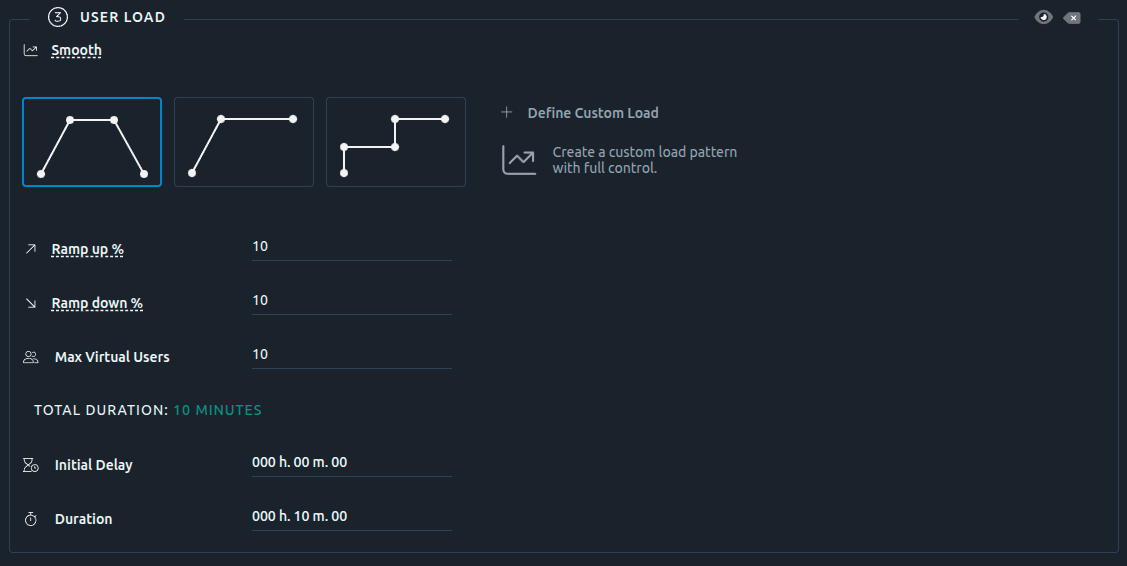
- Smooth to configure a load that increases to peak, stays constant for a while, then decreases,
- Sustained to configure a load that increases to peak and stays constant for a long period of time,
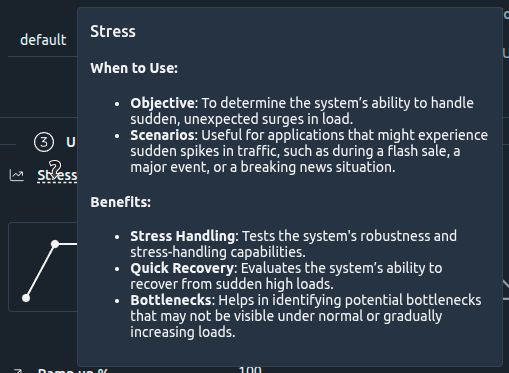
- Stress to simulate peaks of traffic,
- Custom to configure a custom user load policy point per point.
Note
Place your mouse hover the user load policy kind to display a tooltip with use-cases and benefits of each configuration.
Smooth
| Input | Description |
|---|---|
| Ramp up % | Ramp up (increasing load at the start of the test) part in percentage of the pattern duration (Maximum 50%). |
| Ramp down % | Ramp down (decreasing load at the end of the test) part in percentage of the pattern duration (Maximum 50%). |
| Max Virtual Users | Amount of concurrently simulated Virtual User at the peak of the load. |
| Initial Delay | Delay before load starts to increase. |
| Duration | Duration of the test when user load is simulated. |
The peak load percentage is 100% - rampUp% - rampDown%. For example with a ramp up of 30% and a ramp down of 20%, the user load will stay at its peak value for 50% of the test duration.
Info
Click on the  icon on the right corner of the User Load step to quickly visualize the user load curve generated by the current configuration.
Sustained
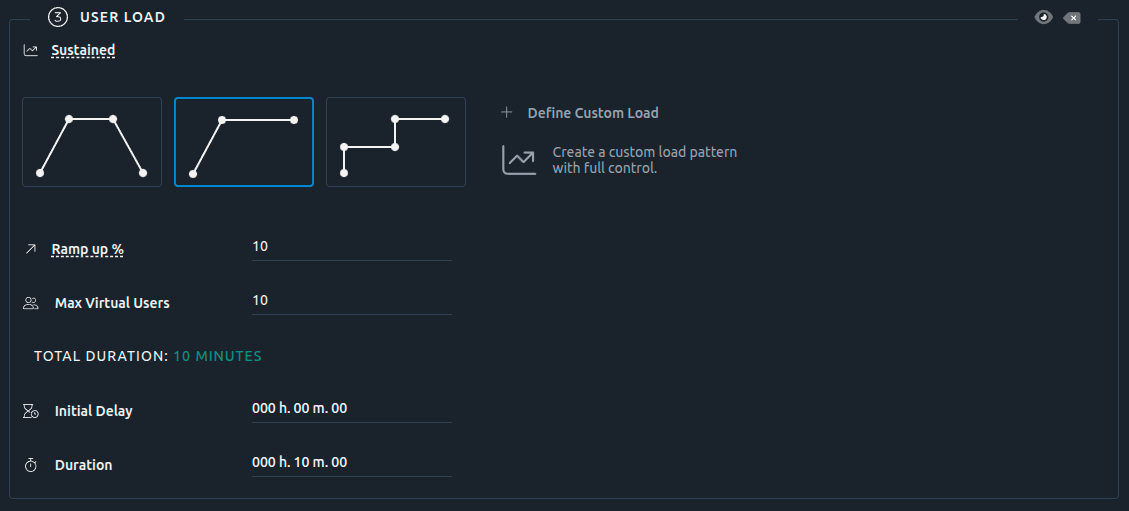
| Input | Description |
|---|---|
| Ramp up % | Ramp up (increasing load at the start of the test) part in percentage of the pattern duration (Maximum 100%). |
| Max Virtual Users | Amount of concurrently simulated Virtual User at the peak of the load. |
| Initial Delay | Delay before load starts to increase. |
| Duration | Duration of the test when user load is simulated. |
The peak load percentage is 100% - rampUp%. For example with a ramp up of 30%, the user load will stay at its peak value for 70% of the test duration.
Info
Click on the icon on the right corner of the User Load step to quickly visualize the user load curve generated by the current configuration.
Stress
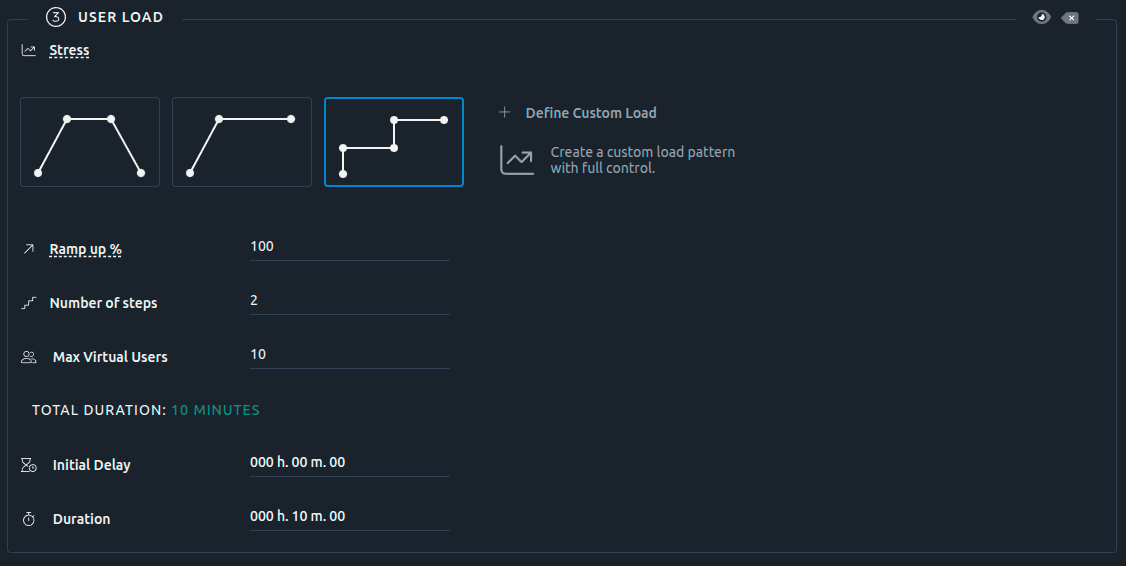
| Input | Description |
|---|---|
| Ramp up % | Ramp up (increasing load at the start of the test) part in percentage of the pattern duration (Maximum 100%). |
| Max Virtual Users | Amount of concurrently simulated Virtual User at the peak of the load. |
| Initial Delay | Delay before load starts to increase. |
| Duration | Duration of the test when user load is simulated. |
The peak load percentage is 100% - rampUp%. For example with a ramp up of 30%, the user load will stay at its peak value for 70% of the test duration.
Info
Click on the icon on the right corner of the User Load step to quickly visualize the user load curve generated by the current configuration.
Custom
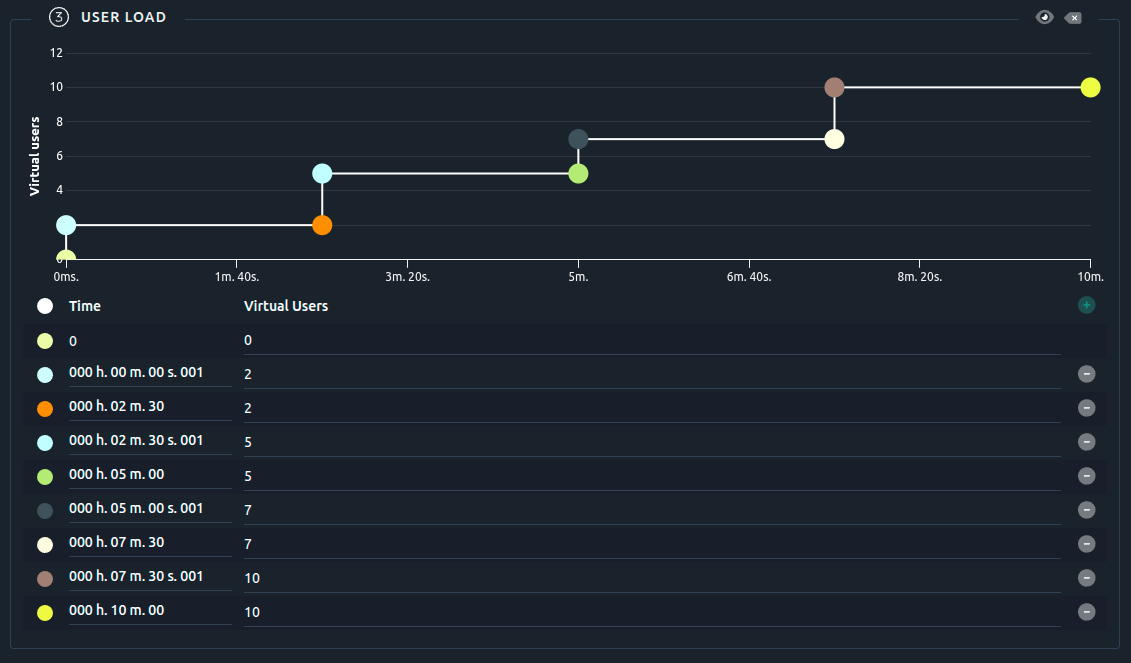
The custom load configuration allows you to precisely tune the user load according to your needs either by:
- Clicking on the user load chart to add or update points,
- Editing the user load table directly.
The usage of the custom load chart and table is the same in a simple scenario and in an advanced scenario user profile. Please refer to the documentation pages listed above for more information.
Options
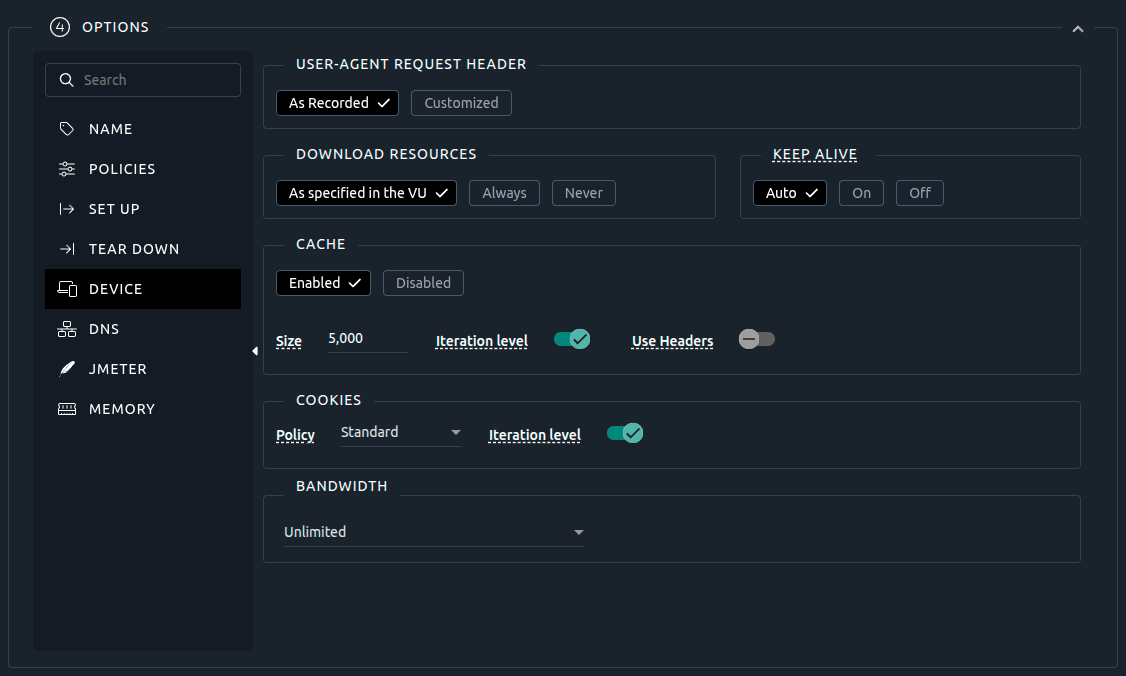
The usage of the simple scenario options is equivalent to advanced scenario user profile options. Please refer to the documentation pages listed bellow for more information:
Integrations and Automation
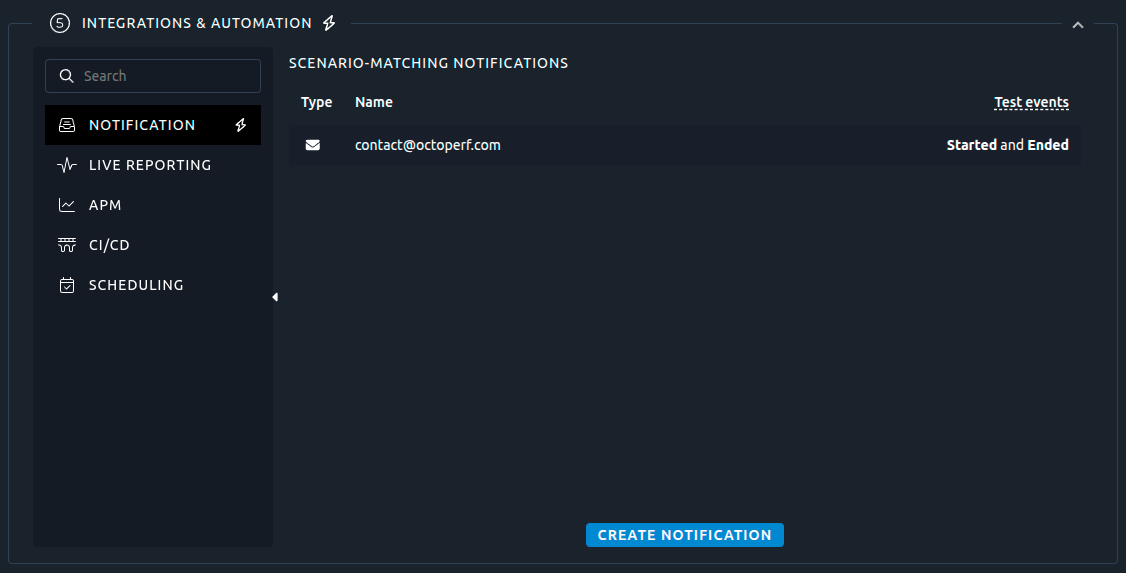
This step gives you unified quick access to various integration and automation configurations. Please refer to the table bellow for more information and documentation links.
| Section | Description | Link |
|---|---|---|
| Notification | A notification is a message sent to an external system when a test reaches a particular status. It allows you to send test reports in PDF format by email or to a Slack channel for example. Notifications are configured per workspace but can filter by scenario name. | Notification Documentation |
| Live Reporting | Live Reporting is used to send the metrics While the test is running in OctoPerf it is also possible to another database or system while the load test in running on OctoPerf. | Notification Documentation |
| APM | Activating an APM integration makes OctoPerf append custom headers to every request sent during the load test. APM is configured per project. | APM Documentation |
| CI/CD | This section displays configuration wizards that help you connect OctoPerf to each Continuous Integration/Continuous Delivery system. | CI/CD Documentation |
| Scheduling | Allows you to list and create scheduled jobs in order to run your tests periodically or once in the future. | Scheduler |
Pass Criteria

This final step gives an overview of Service Level Agreements configured at the Virtual user level or for the whole project as well as monitoring connections:
- All SLA profiles user in the Virtual User: List all SLA configured for the current Virtual User,
- SLA thresholds applied to aggregated test metrics: List all SLA monitoring connections configured for the current Project,
- Thresholds on server, database, or system-level metrics: List all other monitoring connections configured for the current Project.
Actions
Several actions are available from the menu located at the top-right corner of the application when editing a Scenario.
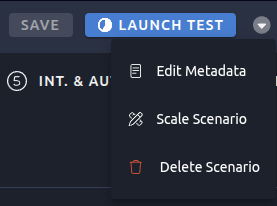
| Action | Description |
|---|---|
| Save | Saves any changes made to the current Scenario. The button is muted if there is nothing to save. The keyboard shortcut CTRL + S can also be used. |
| Launch Test | Opens the launch test page. |
| Edit Metadata | Change the scenario name, description and tags. |
| Scale scenario | Rescale the scenario duration or load. |
| Delete Scenario | Remove this scenario. This operation cannot be reverted so proceed with caution. |
Edit Scenario Metadata
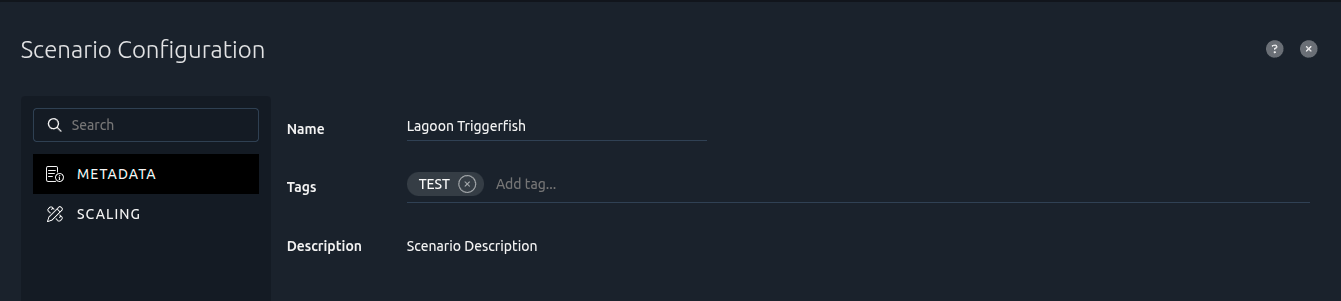
This screen allows you to rename your scenario or change tags and description.
Info
The description can contain markdown/HTML, it can be configured with our code editor.
Scale Scenario
This option allows you to change the Maximum concurrent users and/or maximum duration for the entire test:
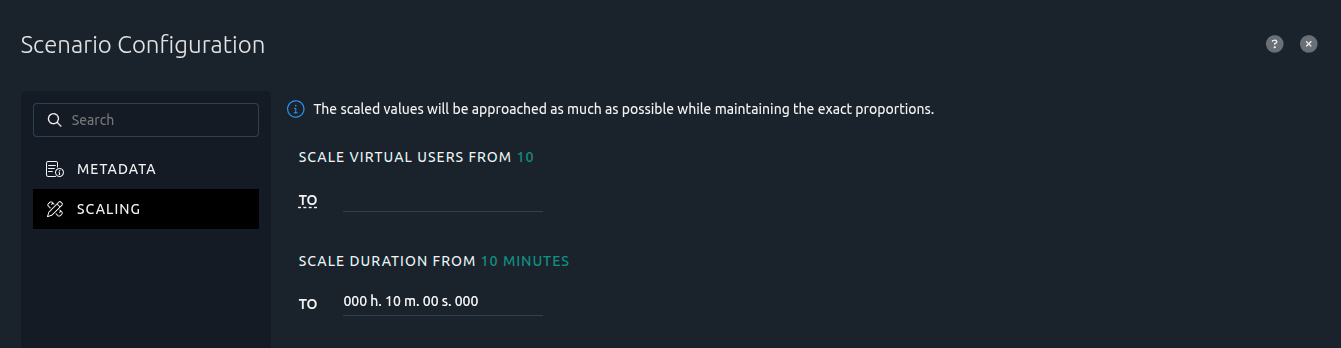
Just enter the new number of concurrent users and duration you would like to launch and we will increase the proportions of each User profile to match this.
Warning
To prevent rounding issues, it is not allowed to downscale the scenario to a Maximum concurrent user resulting to 0 for one of the User Profiles.
Delete Scenario
Clicking on Delete Scenario opens the following dialog:
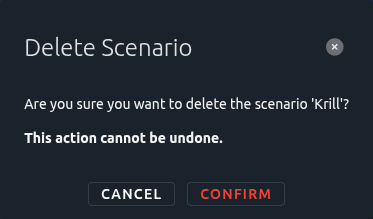
Click on Confirm to effectively delete the scenario.
Warning
This operation cannot be reverted so proceed with caution.