Usage logs
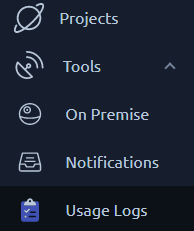
The usage logs show what happened in the workspace: the tests launched, and who created, modified or deleted what, and when. Open them from the upper menu:
Use them to:
- track the license use of your team: each test launched stays listed, even after its report was removed;
- find who changed an element, such as a virtual user that no longer behaves as it did yesterday;
- find what disappeared: a deleted scenario, a removed member, a deleted project.
What is recorded
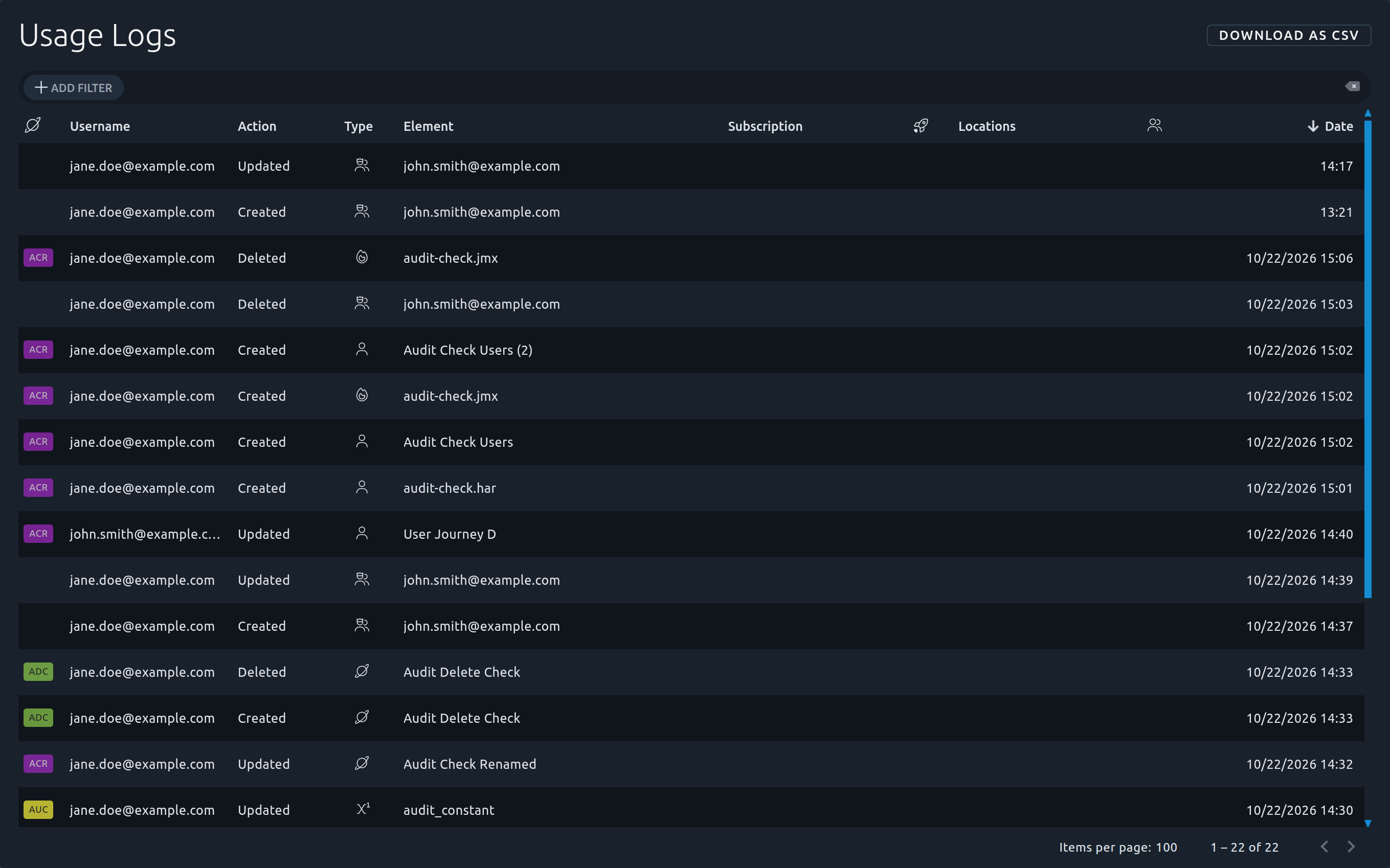
Each line is one event, the most recent first. Its Action is one of:
- Test launched: a test was started from a scenario of the workspace;
- Created, Updated or Deleted: an element of the workspace was changed.
The changes are recorded since OctoPerf 18.1.0: those made before are not listed, while the test launches go further back. A change is recorded whether it was made from the web interface, the API or the MCP server. An action that fails, or that your role refuses, records nothing. The changes cover these element types:
| Element type | What is recorded |
|---|---|
| Virtual User | Created, including the imports (HAR, JMX, LoadRunner, Postman, Playwright, k6, list of URLs...), the copies and the sample virtual user; updated, including an import into an existing virtual user; deleted. |
| Scenario | Created, including the duplicates and the JMX, LoadRunner and Maven imports; updated; deleted. |
| Server | Created, updated, deleted. Removing the unused servers adds one Deleted line per server. |
| Variable | Created, updated, deleted. |
| Report | Created, including from a template; updated; deleted. |
| Project | Created, updated (renamed, its description changed...), deleted. A project moved to another workspace is listed as Updated in its new workspace. |
| Member | Added to the workspace, role changed, removed. |
Not recorded
- The report created by a test launch: the Test launched line stands for it.
- The elements deleted along with their project: only the project gets a Deleted line.
- The servers and variables that an import creates along with the virtual user.
- The project files.
One Updated line per person and element
All the saves of one person on one element make one Updated line, dated by their last save, whether they saved ten times in a row or over several weeks. When two people work on the same virtual user, each one gets a line.
Each line shows the names as they were when it was written: the name of the element and of its project at the time of the event, or of the last save for an Updated line. A line about a renamed element keeps its former name, and the lines of a deleted project stay readable.
How long the logs are kept
Changes are kept 6 months and test launches 2 years. An element saved since keeps its latest Updated line: only the history of the elements left alone ages out. On an on-premise installation, old logs are removed only when the data eviction is enabled, and both durations can be changed there.
Columns
A test launch also fills the columns that describe the test: its subscription, the tests it used, its locations and its concurrent virtual users.

| Column name | Description |
|---|---|
| Project | The initials of the project of the element, or of the project from which the test was launched. Move your mouse over them to read its name. |
| Username | Who launched the test or made the change. |
| Action | Test launched, Created, Updated or Deleted. |
| Type | The icon of the type of element the line is about. Move your mouse over it to read the type: Virtual User, Scenario, Server... |
| Element | The name of the element. |
| Subscription | For a test launch: the subscription it used. |
| Test(s) used | For a test launch: the number of tests it consumed. |
| Locations | For a test launch: the locations it ran from, separated by commas. Move your mouse over them to read the full list, one location per line. Give your on-premise locations distinct names if you want to tell them apart. |
| Concurrent Virtual Users | For a test launch: the maximum number of concurrent virtual users. |
| Date | When the event happened. For a series of saves, the date of the last one. |
Click a column header to sort the table on it: project, username, action, type, element or date. By default, the most recent line comes first. A name too long for its column is cut: move your mouse over it to read it in full. The table shows one page at a time: use the arrows at its bottom to move between pages.
Filter the logs
Click + Add filter to narrow the table down. The filters add up: for instance, Element Type Virtual User and Action Updated list the virtual users that were modified, by whom and when.

| Filter | Keeps the lines |
|---|---|
| Action | Of the Test launches, of the Changes (created, updated and deleted together), or of one single action. |
| Element Type | About one type of element: scenario, virtual user, server, variable, report, project or member. |
| Element | Whose element name contains the text you type, whatever its case. |
| Username | Of one member of the workspace. |
| Project | Of one project. |
| Date | Within a date range. |
Each filter is shown as a chip above the table: click it to change it, or click its cross to remove it. The general use of filters is detailed in this section of the navigation page.
Current limits of the filters
- The Element filter always keeps the names that contain your text, whatever its case: the other options of its dialog (Equals, Starts with, Not contains...) and the case setting are not applied yet.
- Username and Project only offer the current members and the existing projects. The lines of someone who left the workspace, or about a deleted project, cannot be selected with them: use the Element filter or the date range instead.
Open an element
Click a line to open the element it is about. Move your mouse over a line to show the buttons at its end:
- on a change, Open followed by the type of element, such as Open Virtual User;
- on a test launch, Open Report and Open Scenario.
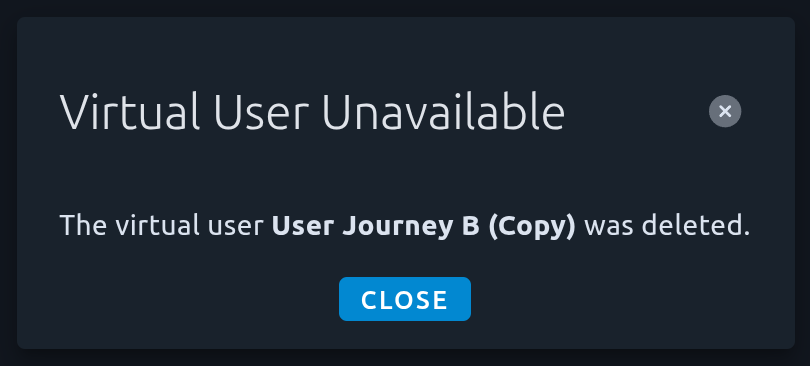
When the element no longer exists, because it was deleted since or its project was, a message says so instead, whatever the action of the line:
When your role does not let you read the element, the message says you are not allowed to open it: a Viewer, for instance, cannot open the lines about members.
Download the logs
Click Download as CSV to get a copy of the lines that match the current filters, the most recent first. Remove every filter to download the whole history.
The file has one column per field: timestamp, username, action, elementType, elementName, parentType, parentName, elementId, parentId. The parent is the project of the element, empty for a member. The file holds the stored values, not the labels of the table:
| Column | Values |
|---|---|
action |
EXECUTE (test launched), CREATE, UPDATE, DELETE. |
elementType |
virtualuser, scenario, httpserver (server), variablewrapper (variable), benchreport (report), project, workspacemember (member). |
A name that a spreadsheet would read as a formula, such as =SUM(A1:A2), is written with a leading apostrophe, so that it shows as text.
Who sees what
Every member of the workspace sees the whole usage logs, test launches and changes, with every filter, whatever their role. Any member can therefore see what the other members did in the workspace, and when.